On The Transition To Becoming A Worker-Owned Cooperative Press
Naseem Jamnia (they/them) writes inclusive speculative fiction for adults, teens, and kids. They're the author of fantasy novella The Bruising of Qilwa—which was a finalist for the IAFA Crawford, Locus, and World Fantasy awards—and middle-grade fungal horror The Glade. An Iranian Chicagoan, pro-library activist, and inclusive writing educator, Naseem currently lives outside Reno with their geologist husband and four furred creatures. Learn more and join their newsletter at NaseemWrites.com and Sword & Kettle Press.
At the beginning of lockdown in 2020, I found a call for an associate editor position at a press called Sword & Kettle. Billed as a press focused on "inclusive feminist fantasy and speculative fiction," Sword & Kettle's website had a masthead of one, the press's founder and editor-in-chief. With a land acknowledgment and professed values of accessibility and representation, it seemed to me a great fit–one where I'd be able to flex my editorial expertise and help shape the future to focus on marginalized voices.
It is now six years later, and I'm now one of three member-owners of this tiny press, which has just become a worker-owned cooperative.
I imagine many small presses start in a similar manner: Someone who loves reading decides they're going to start printing zines or hosting a website to publish others. Sword & Kettle started at Kay Marlow Allen's (they/xe) kitchen table while they were in college, and while it paid only a token sum to its authors, it did so out of Kay's pockets and kept submissions free.
When I joined Sword & Kettle, Kay wanted to plunge into a new venture. The press already hosted Corvid Queen, an online literary magazine of feminist fairy tales, and had printed two limited-run fairy tale chapbooks. Kay was bringing on two new editors to create "mini-chapbooks": limited-run, hand-bound editions of either one short story, a handful of flash pieces, or a handful of poems.
To our immense pleasure and surprise, our first mini-chapbook series, Cup & Dagger (a play off our press name) was an explosive success. We published 100 copies each of seventeen chapbooks on sturdy cardstock, with a full-color commissioned cover. With bookbinding tools in hand, we settled into the rhythm of our process: Fold each piece of cardstock in half with a bone folder to ensure a crisp fold, creating the spine of the chap; for each page, in the middle third of the spine, punch three evenly spaced holes with an awl; and finally, use a needle and waxed colored thread (chosen to match the chap’s cover or vibe) to bind the pages together, weaving so each end of the thread lies in the middle of the open chap to be tied off. It was exhausting—and extremely rewarding—work.
Fast-forward through the next several years. Jessie, who had joined the team when I did, stepped back. We decided to leave social media in favor of building out our newsletter, Patreon, and Discord, and the Cup & Dagger author we'd brought on as a social media manager, Jude Gardner (she/they), joined the editorial side. We were a small operation, informal between projects and intensely dedicated during.
At the end of 2022, Kay floated the idea of transitioning to a worker-owned cooperative. Xe was not comfortable being the decision-making "head" of a press, not when all of us put in so much work and brought our own perspectives and expertises to the table, and wanted to do more research on what that would entail. Xe told us xe'd been reading up on worker-owned cooperatives, where everyone was legally an owner of a business and were entitled to equal decision-making power within it.
Kay saw the unequal hierarchy as antithetical to our values as both individuals and a press. We'd all become more radical in the intervening years, and our values as anticapitalist, decolonial, sustainable, accessible, and inclusive couldn't be reconciled with a "business as usual" approach. While we were only a three-person team, the point seemed moot, but what about the future of the press? Kay had put in thousands of dollars of xer own money into the press, and neither xe, nor I, nor Jude were paid for the work we did.
Jude and I were interested, though hesitant; what would it mean to go into business with these other two people, who by now had not only become coworkers but friends through an ongoing global pandemic?
We are three queer, gender-variant, disabled, and neurodivergent people. I am a racialized child to immigrants and have consistently brought forth that perspective and focus. All three of us want to do and be better in an industry that often pays only lip-service (at best) to our values, and in a larger society that openly eschews them. It became obvious that this was not only the right choice, but the only choice for us.
At first, we tried to figure out what this would look like on our own. That meant figuring out our roles, which were fluid with such a small team. Jude wanted to focus on editing poetry and hybrid works, while I found a surprising passion for book layout and design, and Kay enjoyed managing both the business and community end. In terms of paperwork, an operating agreement couldn't be that hard to figure out, right? Surely we could write our own bylaws and figure out how to restructure the press in a way that made sense.
Wrong! Buried in the weeds, it became quickly obvious that we had no idea what we were doing. Would "members" who owned the press be its employees—us—or also include our authors? Could outside readers buy (figuratively and literally) into our structure? How did a "board of directors" play into this?
So we applied for a grant through CLMP, the Community of Literary Magazines and Presses, to work with the International Cooperative Alliance on what this transition would entail. The result has been the last year of work, meeting regularly with ICA's consultants to go through the principles of cooperatives, the nitty-gritty of monetary transparency, fair decision-making practices, and formal governing frameworks. We've created (and are still creating) internal policies, have begun to formalize our roles, and are in the process of figuring out what expectations we have and how to be accountable to each other and ourselves in a way that's fair and judgement-free.
At every step, we've asked ourselves: How do we take what we're learning and apply it in a way that is in line with our values? A cooperatively owned business is still a business, which we especially realized after participating in the Participatory Management Initiative through the Cooperative Development Institute and spoke to other cooperatives. How can we prioritize our authors while also acknowledging (and compensating) our own labor? How can we create a press that focuses primarily (though not solely) on a niche area—beautiful mini-chapbooks—that consistently champions marginalized voices? What kind of structure will allow us to support other tiny presses with similar values by sharing our resources and experiences? How can we foster literary community as a consistent part of our focus?
We’ve had existential questions, too: How do we actively cultivate a space where racialized authors feel safe to send us their work, and communicate that effectively? Can we continue to call ourselves a “feminist” press when white feminists have co-opted the movement? How do our own experiences and identities align with what we’ve historically published, and what we want to publish in the future?
How do we do all of that while also acknowledging—and honoring—our own capacities and other commitments?
We don't have all the answers yet, and we've probably got growing pains ahead of us. Our ambitions include sharing what we’ve learned with other small presses and offering craft-based workshops through local bookstores. And, of course, we hope to bring in new folks: a community manager to cultivate our Discord and Patreon; editors on both the press and Corvid Queen sides; someone focused on marketing and fostering connections with bookstores and community partners.
For now, we've done a little rebranding to be more in line with our values. Corvid Queen is focused on fairy tales from the margins. Sword & Kettle is a tiny press publishing queer and inclusive speculative literature.
It's been ten years since Kay sat at their kitchen table and decided to open the press. It’s been six years since I answered the call for an associate editor. It’s been five years since Jude applied to be our social manager. Now, we’re three worker-owners of a cooperative press. We're psyched to see what the next decade brings us and how we can make a positive impact in this industry.
Sword & Kettle’s Ten Year Anniversary Sampler
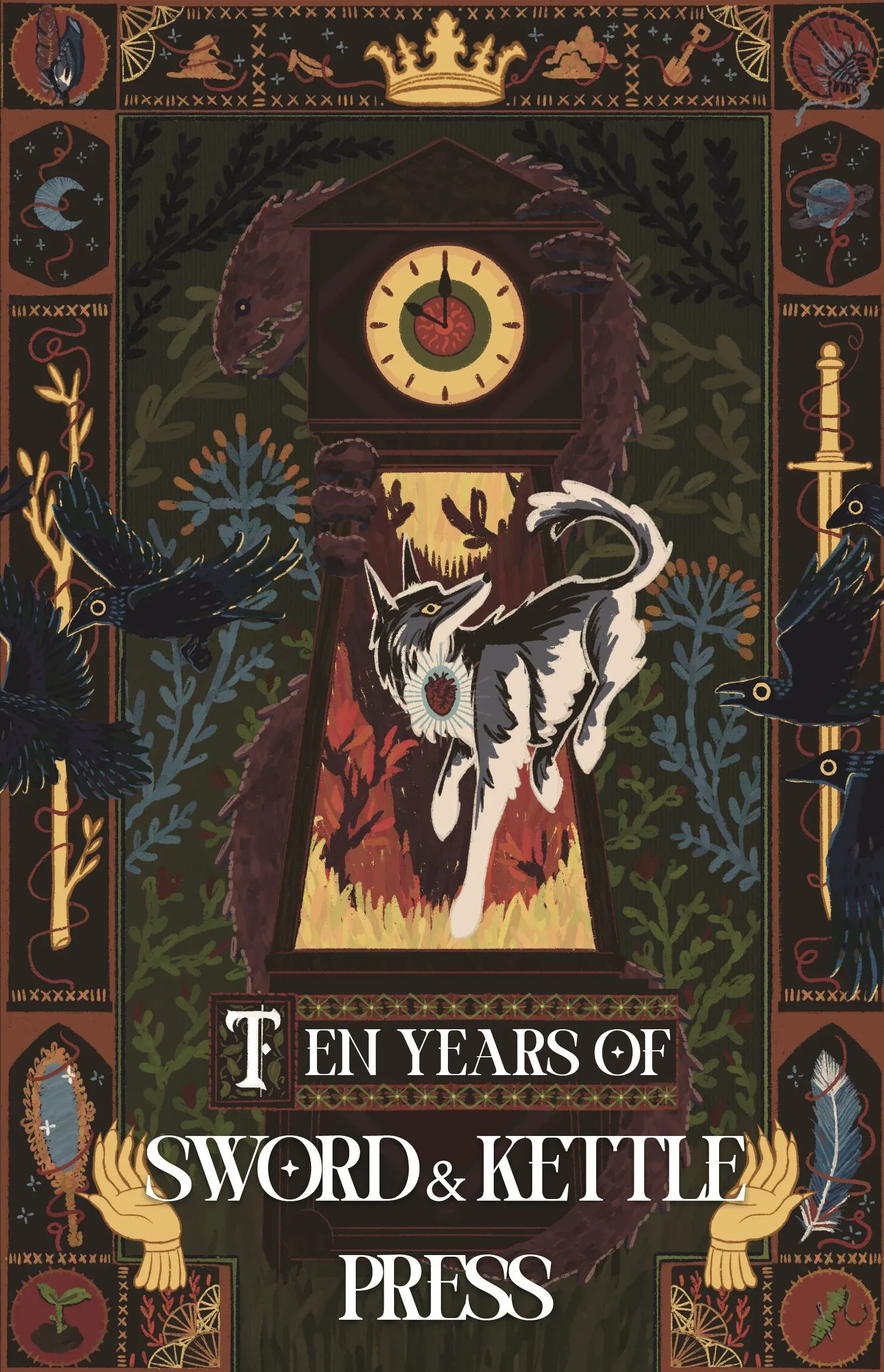
From our humble beginnings at a college student’s kitchen table, Sword & Kettle Press has grown into a beautiful home for queer and inclusive speculative literature. We’ve proudly crowd-funded three successful campaigns and published two chapbook series, four standalone titles, an online literary magazine, and two digital zines.
This anniversary sampler celebrates ten years with Sword & Kettle Press, and all of the works that have played a role in that journey. Featuring excerpts from our many wonderful chapbooks, this inclusive compilation will span years and genres, enticing audiences both new and old. The final product will include original cover artwork from Nimaël and over 200 pages of works from previously published authors. It will be available to back on Kickstarter in mid-April and will ship beginning in July.
Original cover design by Nimaël



Member discussion